logo elektroda
logo elektroda
X
logo elektroda

Internet radio and audio file player on ESP32-S3

MAJSTER XXL 190353 2073
ADVERTISEMENT
Treść została przetłumaczona polish » english Zobacz oryginalną wersję tematu
📢 Listen (AI):
  • #2071 21802643
    hevet
    Level 17  
    >>21801120 I doubt that stations would be interested in such an addition, at least some. There are cases that even some do not wish their links to be included in the listing pages. Presumably it is a matter of using their sites, where they are known to place advertisements.

    Added after 2 [minutes]:

    saper135 wrote:
    >>21800284
    I know there is a program where you add the appropriate components, but as far as I can see it supports the old ESP32. https://e2002.github.io/docs/myoptions-generator.html
    And that is the whole secret of this device, connecting all the components correctly.


    This is not a configurator for EVO Radio but for Yoradio, I don't know why people often confuse the two projects.
  • ADVERTISEMENT
  • #2072 21802741
    bernix
    Level 11  
    DJCheester wrote:
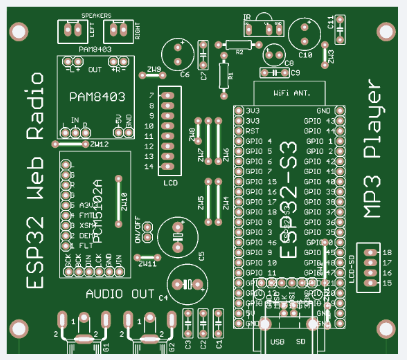
    Welcome, as a small error has crept into the gerber files, I am adding a corrected version.

    The error is in the descriptive layer (the paths are as they were before) so the thermotransfers are fine

    On the already ordered boards there will be a bit of chaos on the description mask.
    I have only now checked this on the JLCPCB website

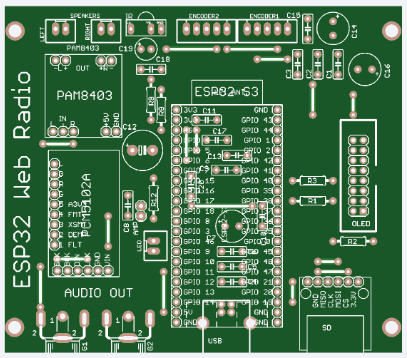
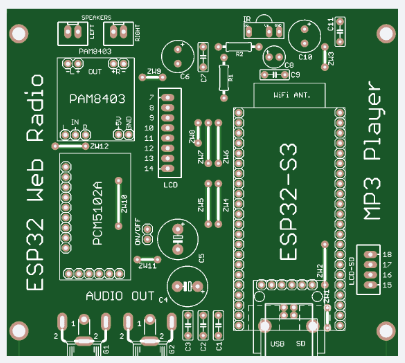
    The Major and Robgold(2enc) boards will look like this

    ESP32 PCB board with component labeling for audio and microcontroller project Green PCB with white component labels and “ESP32 Web Radio” printed on the left

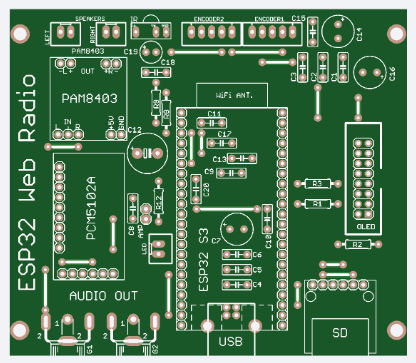
    After correction yes

    ESP32-S3 PCB with labeled audio and MP3 circuit components Green PCB labeled ESP32 Web Radio with audio and SD card component markings


    This is what happens when you have too many versions of libraries.

    For those who have already ordered, I apologise for misleading you

    The Robgold 1-enc version of the board was done before and correctly so the fix only applies to the other two.

    Corrected heat transfers attached

    Regards ...


    And could you reveal specifically where the error broke in?
  • ADVERTISEMENT
  • #2073 21802786
    DJCheester
    Level 27  
    You can see on the description layers the pin names electrically are uncorrected.

    This can be seen in the scenes before and after the change.

    Regards...
  • #2074 21802948
    bolszoy
    Level 11  
    Fellow MAJSTER XXL. Any chance of a version for an encoder or two as in v1?
    I personally didn't like the remote control, nor the beejers on the phone.
    A lot of work goes into it, but for me version one was the simplest and best. Of course I don't mean to offend anyone.
    Regards.
📢 Listen (AI):

Topic summary

The discussion centers on the development of an internet radio and audio file player based on the ESP32-S3-WROOM-1 module, featuring a custom-designed prototype PCB with OLED display and user controls including rotary encoders and buttons. Key challenges addressed include pin spacing discrepancies in the ESP32-S3 module footprint, integration of Wi-Fi connectivity with dynamic station list updates, and handling of Polish character encoding on the OLED display. The project uses Arduino IDE (version 2.3.2) with ESP-IDF support and requires enabling PSRAM. Audio playback supports MP3, AAC, and FLAC streams, with the ESP32-audioI2S library recommended over the incompatible Audio library. Users reported issues with SPI MISO pin assignment causing bootloader conflicts, resolved by reassigning MISO to pin 35. The project incorporates WiFiManager for network configuration, EEPROM and SD card storage for saving last played station and settings, and includes plans for tone control via an external KA2107 equalizer and a CS8673 amplifier module. Problems with encoder input stability and memory limitations for Bluetooth A2DP on ESP32-S3 were noted. The community suggested alternatives like KaRadio and ESP32-MiniWebRadio projects. Debugging tips include serial terminal logs for HTTP errors and flash memory erasure to resolve boot loops. The project is open-source on GitHub, encouraging forks and modifications. Additional features under development include browser-based updates, directory navigation, and potential audio recording to SD card.
Summary generated by the language model.
ADVERTISEMENT