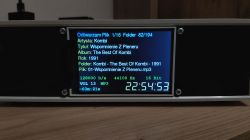
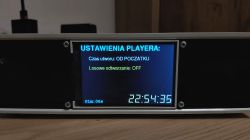
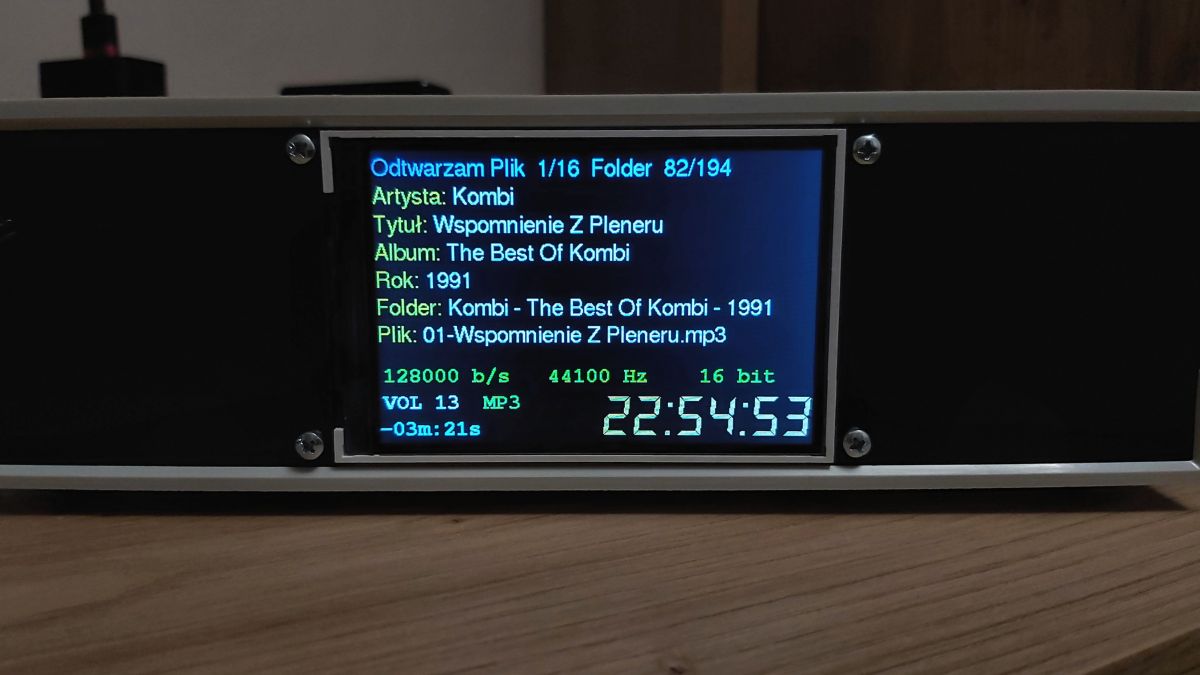
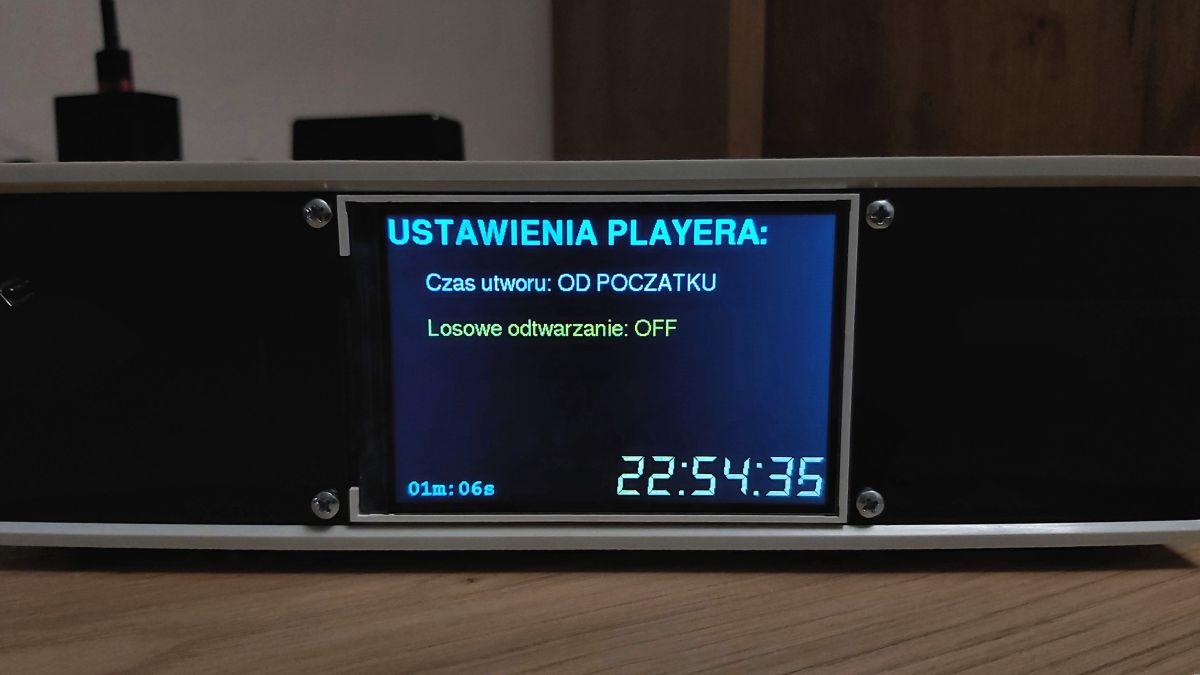
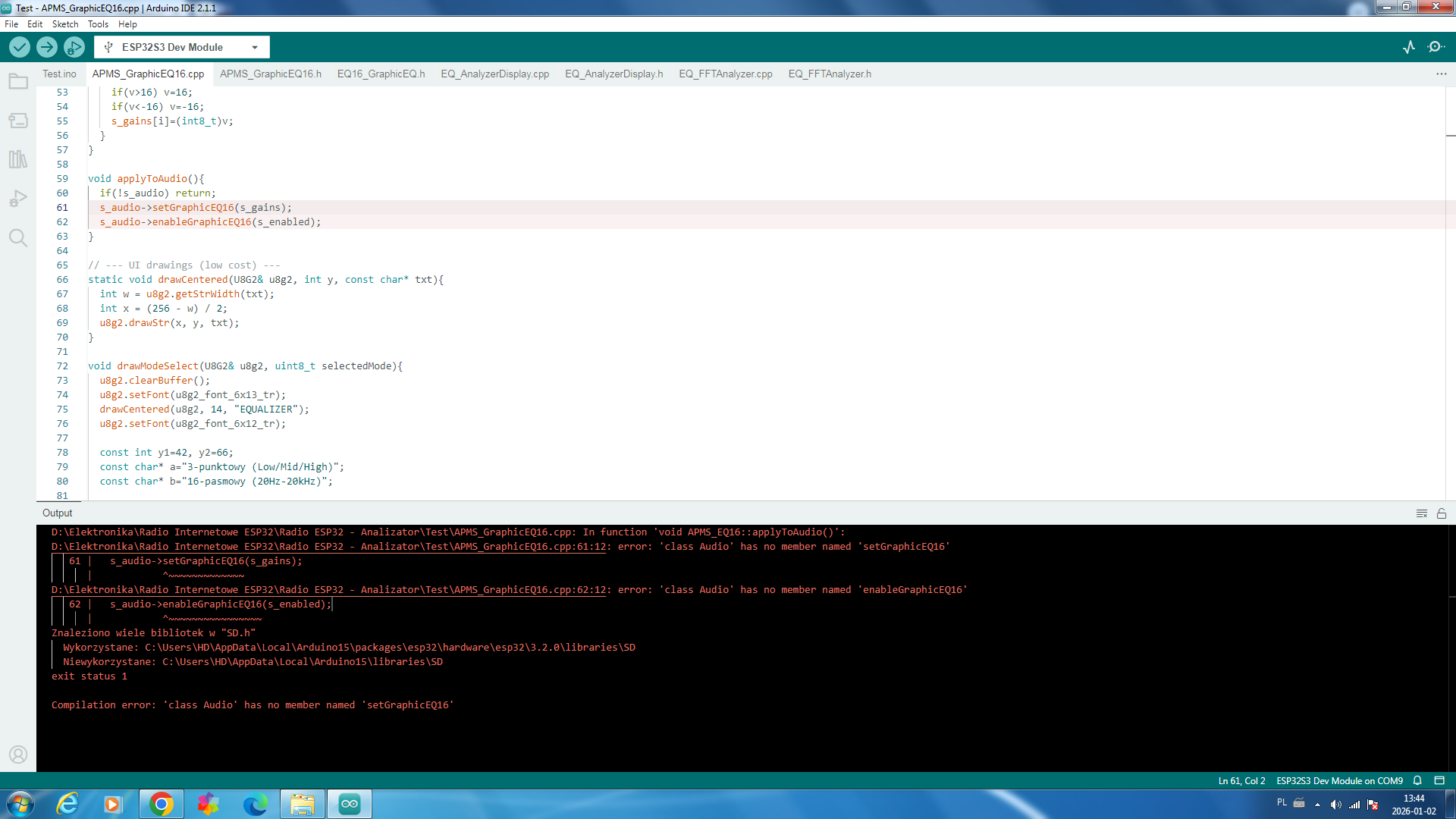
I made a second menu, this time for the audio file player. In the settings, there are options to toggle the display of the song time from the beginning or from the end (I'm currently practising on MP3 files) and to enable/disable random playback of files from the current folder. I calculate the duration of an MP3 track with a fixed bitrate based on its size in bytes and its bitrate, which is the number of bits played per second. I first convert the file size from bytes to bits (multiplying by 8) and then divide this value by the bitrate in bits per second. The result of this operation gives the total duration of the song in seconds. The time counting code still needs to be refined, as some mp3s count incorrectly, I will collect the time for flac files using a different method, as the audio library returns the number of seconds for the loaded file.
Below are screenshots of this menu in action, the code is available at a known location.
I'm also testing no Majster cool that I can finally have my stations in Bank01.txt without worrying that it will overwrite your
I have uploaded Bank17.txt to GitHub for streaming.
The radio does not download this bank automatically (unless you change the declarations in the code #define bank_nr_max 16 to 17). In this bank are ONLY FLAC streams of which from station 44 (AIDA Radio) are HiRes 24bit 1000-2500kbps. If someone would like to test for themselves, it is possible to swap in Bank 16, add to Bank 15 or make a test compilation with Bank 17. It doesn't all work perfectly yet, sometimes the library can reset the radio with such a load.
The ESP32 S3 does not get up when the power is switched off. After some time, when I switch it on again, it locks up. I have to reset with a button. Any hints are there? The radio works fine. I am satisfied, thank you to the creator.
It's the ESP module's fault I have one too, after a long time after plugging in the power it goes dead, after pressing the reset button it gets up normally. I have tried replacing it and changing the capacitor at the reset button, but to no avail. Such modules do happen.
Best regards...
Added after 7 [minutes]:
Lechuuu wrote:
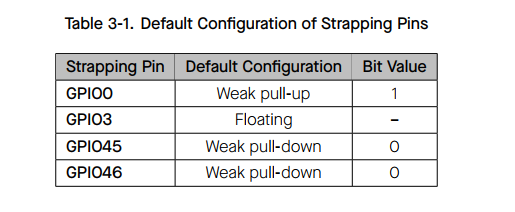
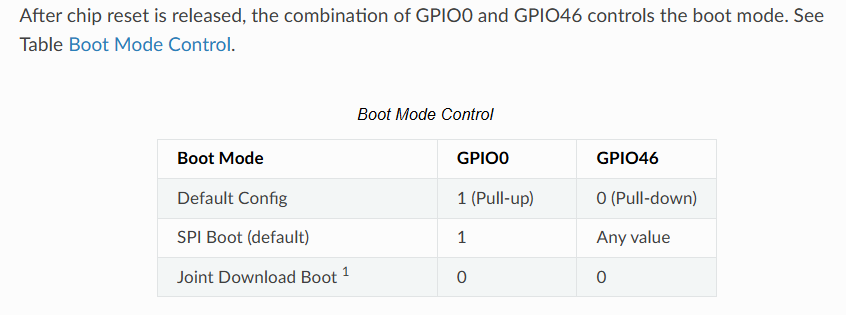
>>21794053 Connect the GPIO0 pin via a 10K resistor to 3.3V and it will always start
Unfortunately this didn't help with me but what's the harm in trying.
Unfortunately it didn't help with me but what's the harm in trying.
Helps 100%, a topic rolled out dozens of times on the yoradio group on fb. It's just that ESP32-S3s have it so that after disconnecting the voltage and switching it on again they sometimes enter the programming mode. No capacitors help here, but what I wrote is checked and works
Tomorrow I will solder again and see only I have to locate this faulty ESP. At least once I remember pulling it up with a resistor and it was fine for a while then after not using it for a week the problem returned.
I will check it again tomorrow.
>>21794069 Works for now. I'll see how after a night's rest, will it catch on? For now it works with a 0 to 3.3V connection.
Here are some settings for that. I guess that's what this is about? (from the documentation)
I have two esp32s3s which did not start, I mean I had one because all I had to do was solder out the capacitor next to the boot button, that is the problem.
@hevet actually there is something in this, there are 100nF capacitors added to the switches and in the manufacturer's documentation these capacitors are marked as not mounted. Also removing the capacitors may help.... When I wrote about the capacitors not helping anything, I was referring to the capacitors on the ESP power supply.
>>21794310 Indeed. Same with RESET. I will desolder both and check. They only serve to prevent the contacts from vibrating. I guess pull-up resistors are a better solution though.
Still in the old year, I wish everyone all the best for this New Year 2026 May this New Year be better than the one currently ending.
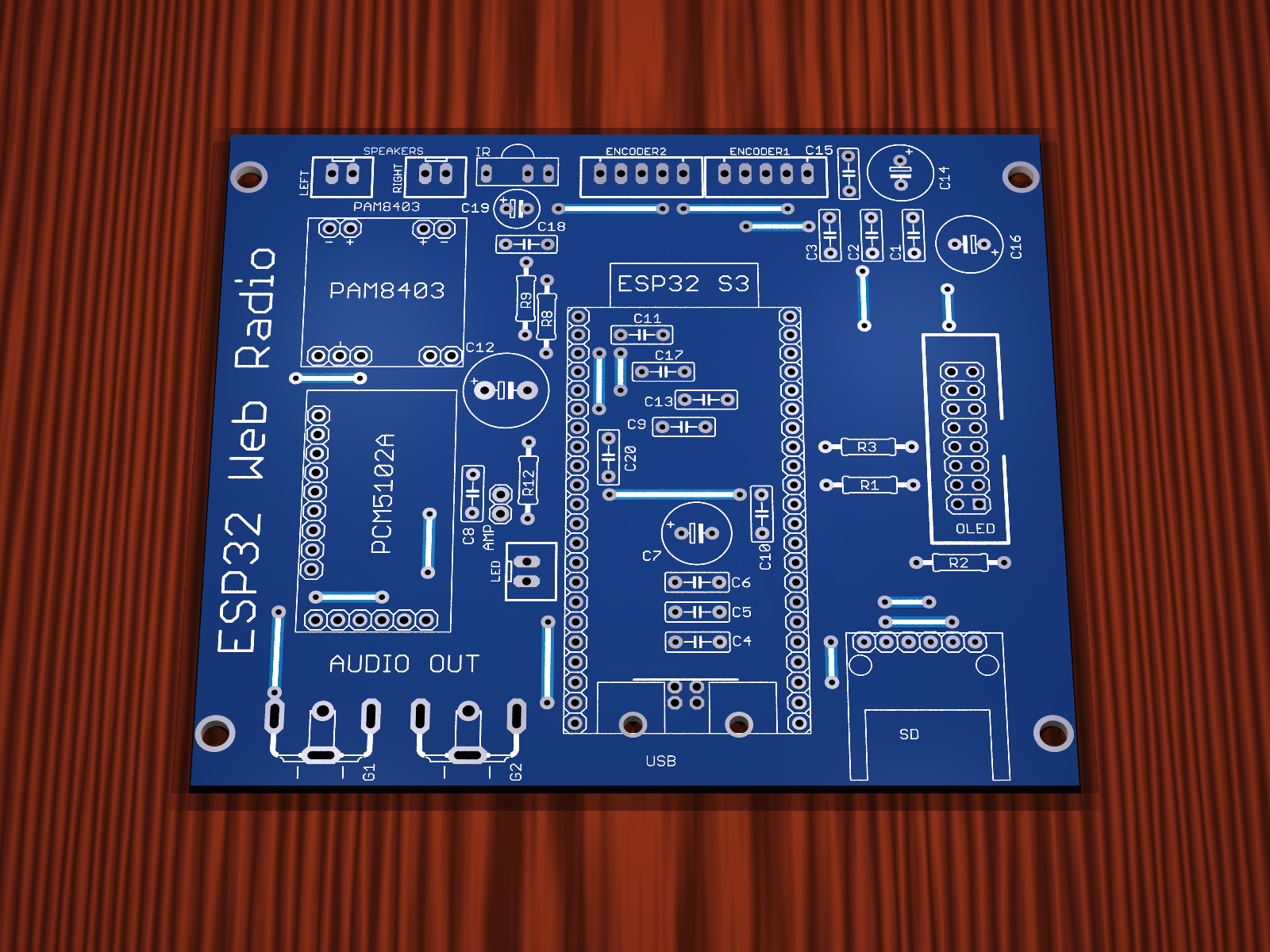
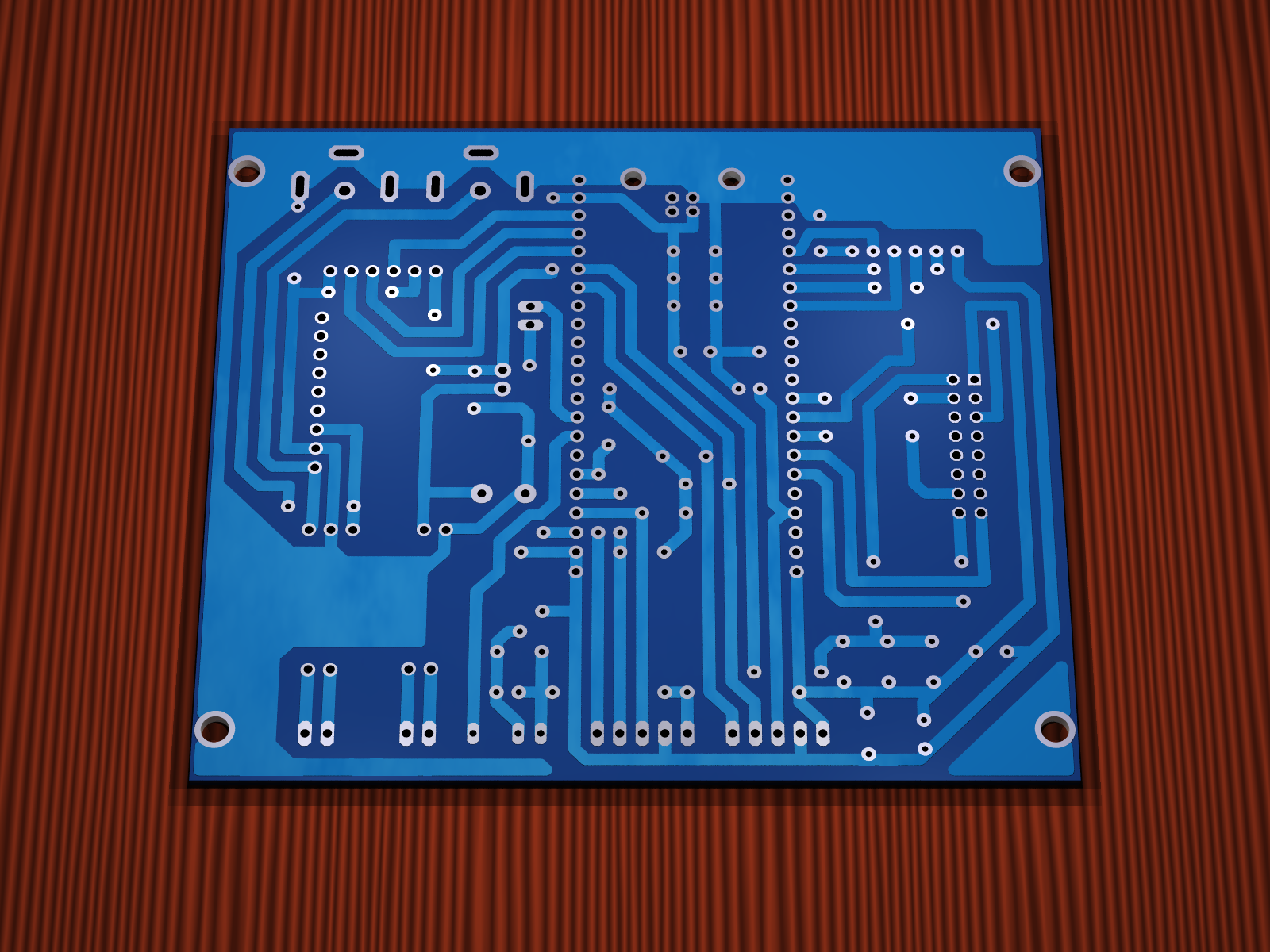
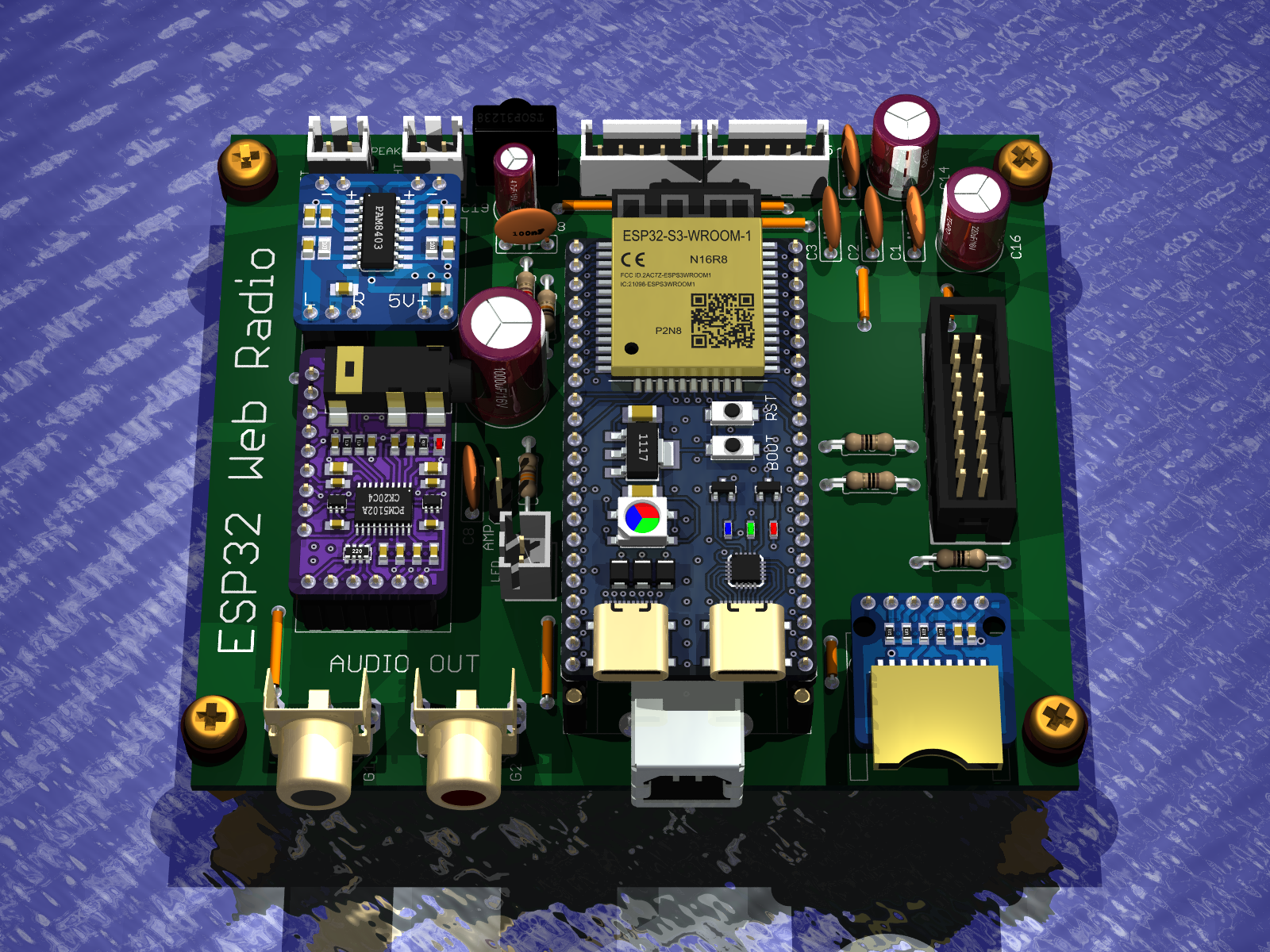
And now the board promised to some under the version of my colleague Robgold with two encoders.
The board is only on through-hole components and ready-made modules.
In addition, I used a PAM8403 amplifier module on the PCB so that small speakers can be connected to the board to make, for example, a kitchen radio.
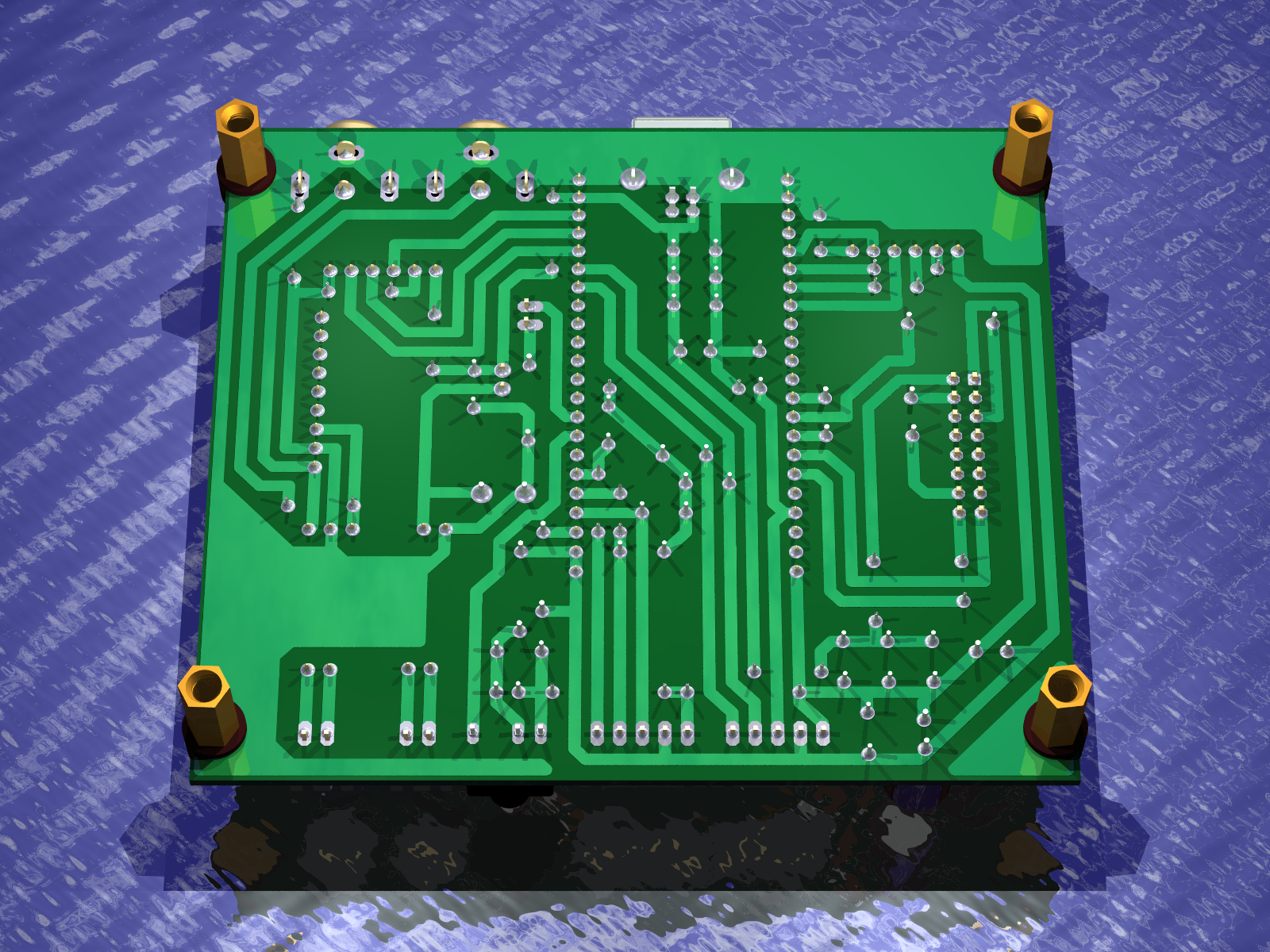
This is how the designed PCB looks like (it is very similar to the previous one with an input for one encoder - the dimensions and mounting holes have been retained)
And this is the model of the assembled radio on this board.
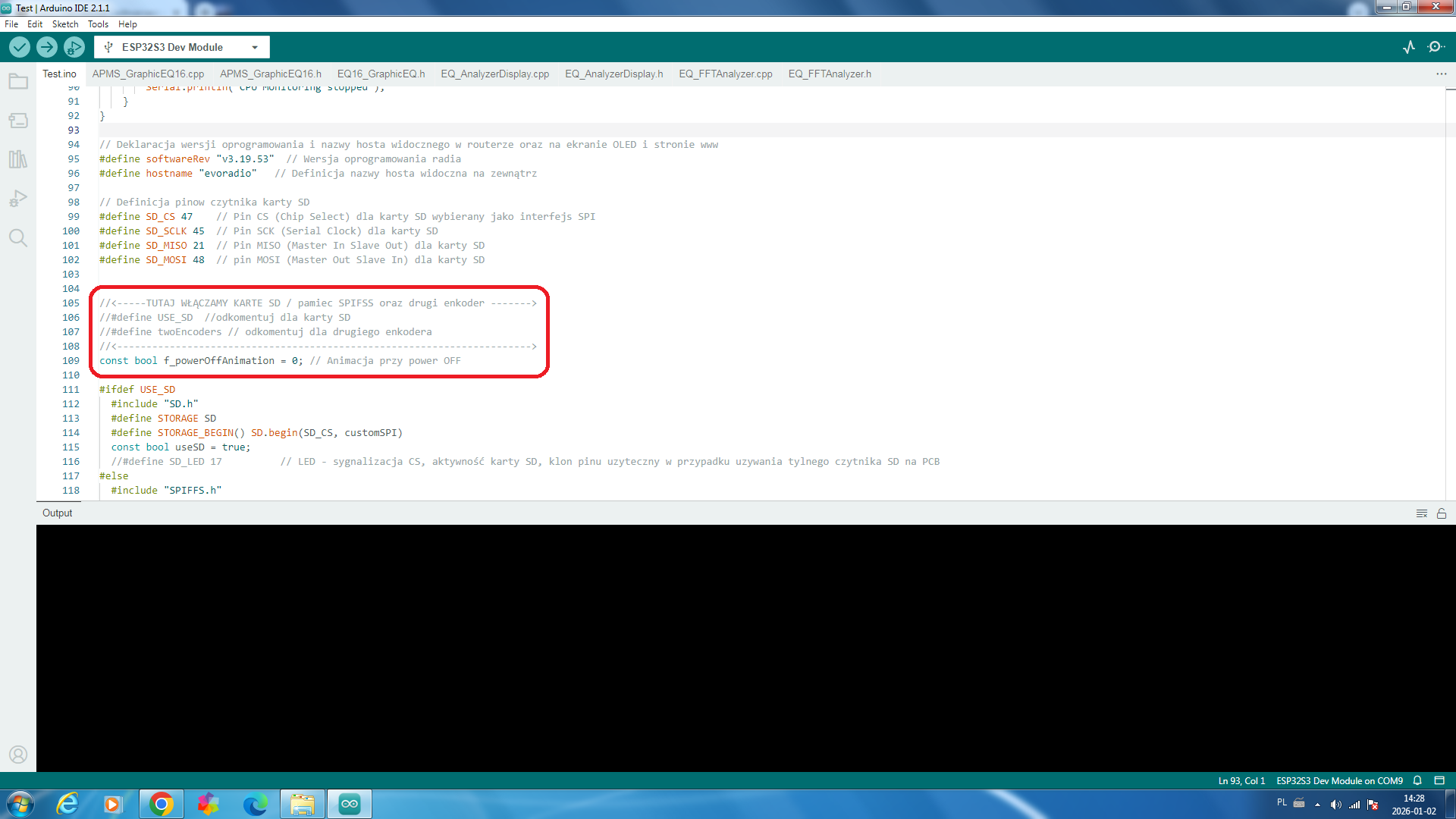
For this version it is possible to upload software of friend Robgold currently 3.19.53
Additionally added output for diode on JST connector
I am attaching the finished gerber file for those who would like to order from China for the tiles
Hello, please find brd files (Eagle CAD) and html partlist files (BOM files) and PDF files for thermal transfer attached.
The attachment contains four versions of the boards, i.e. under Robgold and Majster software
1. PCB for Robgold software v3 evo (up to the latest software version 3.19.53 with one encoder)
2. Board under Robgold software v3 evo (up to the latest software version 3.19.53 with two encoders)
3. PCB under Majstra v3 Color LCD software - works with the latest version made available by the author
4. Experimental board under a different ESP module (specifically ESP32 S3 Uno) - running overlay on ESP module
All projects except the last one include a PAM8403 amplifier.
When creating single-sided PCBs by thermal transfer, you need to remember to use the jumpers marked on the PCB.
When ordering from china boards, the jumpers are made on the top layer of the PCB so you do not need to install them.
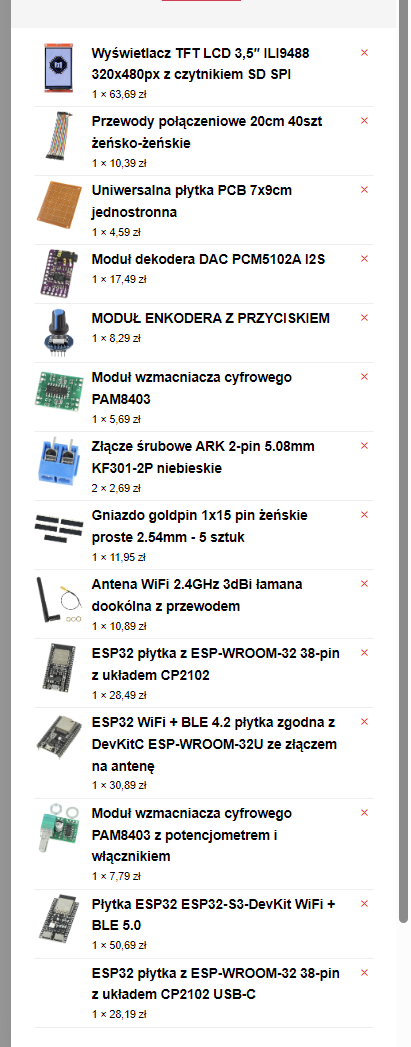
Hello everyone. As I'm a layman, but I like to play, and after reading I see it's fun and even inexpensive, I have a big request. If someone who knows a bit about this, and I see you are quite good at it, could help me with the hardware for this game. I know that you need an ESP32, but the choice on the Polish market is large, and on the Chinese market infinite. I'd like to buy a good one, reasonably up-to-date and, most importantly, one for which there is freely available software and expert help, and it's not about the PLN30 cheaper.
ESP32, from what I can see, there are with built-in antennas and with external antennas, newer ones on USB-C, WROOM-32U, WROOM-32, WROOM-32 38-pin with CP2102 USB-C chip, WROOM-32 30-pin with CP2102 USB-C chip. There's a whole bunch of these and I'm completely lost. Maybe also some larger LCD display, as I'm old and have poor eyesight.
Discussion of a DIY internet radio and SD-card audio player built on an ESP32-S3 with an OLED display, rotary encoders, buttons, and a front-panel interface. The project uses Wi‑Fi to download station lists from GitHub/public stream databases, supports MP3 and later AAC/FLAC playback, displays metadata including Polish characters via a modified font table, and stores settings such as station/bank selection and volume. The thread covers PCB design in EasyEDA, ESP32-S3 module pin spacing issues, PSRAM and Arduino IDE setup, library compatibility problems, SPI/I2S wiring, SD card reader boot issues, encoder behavior, WiFiManager-based network setup, and troubleshooting of crashes, HTTP download failures, and audio initialization errors. Several improvements were added over time, including station selection by encoder, time sync, browser update support, and saving settings to card memory. AI summary based on the discussion. May contain errors.